


IPL Pigmentation Treatment Norwich
For freckles, sun spots, age spots and suitable areas of uneven pigmentation
Brown marks can be surprisingly difficult to get rid of once they appear.
Maybe you have a few obvious sun spots that seem to have arrived overnight, freckles that have become more noticeable with age, or patches of pigmentation that make your skin look uneven even without makeup.
The important thing is that not everything brown is the same thing, and not every type of pigmentation should be treated in the same way.
At Alison Mary Aesthetics in Taverham, Norwich, I use DPL light treatment to target suitable pigmentation by selectively heating excess melanin within the skin.
The first job is not simply to treat whatever looks brown. It is to work out what the pigmentation actually is, how it behaves and whether light treatment is appropriate for it.

At A Glance
-
Treatment: DPL / IPL Pigmentation Treatment
-
Used for: Freckles, sun spots, age spots, superficial pigmentation and suitable areas of uneven sun damage
-
Price: from £75
-
Treatment time: Approximately 20 to 45 minutes
-
Downtime: Usually mild temporary redness. Treated pigmentation can temporarily become darker before fading or flaking away
-
Treatment plan: Often 1 or more treatments depending on the pigmentation
-
Clinic: Taverham, Norwich, NR8
-
Parking: Free private on-site parking
What Kind of Pigmentation Do You Have?
Pigmentation is really just a description of extra colour in the skin.
The more important question is why that colour is there.
Different types of pigmentation can look very similar at first glance but behave very differently when exposed to light, which is why I do not treat every brown mark as though it is the same problem.
I have flat brown sun spots or age spots
These are often solar lentigines, sometimes called sun spots, age spots or liver spots.
They commonly appear on areas that have had years of UV exposure, particularly the face, hands, chest and shoulders.
When they are flat, benign and appropriately assessed, this type of localised epidermal pigmentation can respond very well to targeted light treatment.
I have lots of freckles
Freckles contain increased melanin and often become darker after sun exposure.
Suitable freckles can respond to DPL, although your underlying tendency to produce freckles does not disappear, so UV protection remains important if you want to maintain the result.
My skin just looks mottled or sun damaged
Sometimes there is not one obvious spot.
Instead there may be lots of small brown areas creating an uneven, mottled appearance across the face.
Where that colour is predominantly superficial melanin from accumulated sun exposure, DPL can be used across the area rather than chasing every individual mark.
I have brown marks left after spots
Brown marks left after acne or inflammation are usually described as post-inflammatory hyperpigmentation, or PIH.
These are different from the flat pink or red marks known as post-inflammatory erythema or PIE.
Some superficial PIH may be suitable for light treatment, but inflamed or pigment-prone skin needs more caution because irritating the skin can sometimes create more pigmentation rather than less.
I therefore assess these individually rather than automatically treating every post-acne brown mark with DPL.
If your marks are pink or red rather than brown, see my IPL redness and vascular treatment in Norwich page.
I think I have melasma
Melasma behaves differently from ordinary sun spots.
It is usually influenced by a combination of pigmentation, hormones, UV exposure and other biological factors, and it has a tendency to recur.
I do not treat melasma as though it is simply another brown sun spot. Light and heat can sometimes aggravate melasma, so it needs a different and much more cautious treatment strategy.
I have one dark or unusual-looking mark
A pigmented lesion that is changing, irregular, raised, repeatedly crusting or bleeding, looks significantly different from your other marks, or simply cannot be confidently identified as suitable cosmetic pigmentation does not belong under a DPL handpiece.
That needs appropriate medical assessment first.


What Treatment Do I Need for Pigmentation?
Different types of pigmentation need different approaches.
This quick guide shows which types of pigmentation are usually suitable for DPL, which need individual assessment, and which should be medically assessed rather than treated cosmetically.
DPL Pigmentation Treatment
Needs Individual Assessment
Medical Assessment First
Best for suitable superficial pigmentation
Not automatically a DPL treatment
Not treated cosmetically
-
Freckles
-
Sun spots
-
Age spots / solar lentigines
-
Mottled sun damage
-
Suitable flat areas of excess superficial pigment
-
Melasma
-
Post-inflammatory hyperpigmentation
-
Deeper pigmentation
-
Pigmentation associated with active inflammation
-
Complex or mixed pigmentation
-
The correct treatment depends on what is actually creating the colour.
-
Moles
-
Changing or evolving pigmented lesions
-
Irregular or unusual dark lesions
-
Raised, repeatedly crusting or bleeding lesions
-
Anything where the diagnosis is uncertain
| from £75 |
Why Choose Alison Mary for Pigmentation Treatment?
Pigmentation is one of those things that looks deceptively simple; something is brown, so surely you just point a pigmentation machine at it? Unfortunately skin does not work like that...
Freckles, sun damage, solar lentigines, post-inflammatory pigmentation and melasma can all look broadly “brown”, but they do not necessarily have the same cause, sit at the same depth or respond to treatment in the same way.
The interesting part for me is working out why something is brown before deciding how I want to treat it.
I spend a lot of time learning about the skin biology behind the treatments I offer, how light interacts with melanin, how wavelength and skin type alter that interaction and, just as importantly, when treatment is likely to create more problems than it solves.
That is also one of the reasons I deliberately chose DPL rather than a basic IPL platform.
My system gives me several different pigment-oriented wavelength bands rather than one generic “pigmentation” setting, so I have more control over the light spectrum I am using according to the target in front of me.
I personally carry out your treatment and keep track of the settings used and how your skin responds, so treatment can be adjusted intelligently rather than simply repeating the same preset every time. And if I am not happy that a brown mark is appropriate for cosmetic light treatment, I will not treat it.
You are not choosing me simply because I own a light machine. You are choosing me because I want to understand what I am targeting before I use it.
What Is IPL & How Does It Treat Pigmentation?
IPL stands for Intense Pulsed Light. The easiest way to understand it is to imagine a very powerful camera flash containing lots of different wavelengths of light.
Different things within the skin absorb different wavelengths. Blood vessels respond to light differently from pigmentation, hair or water within the skin, which is why different lasers are built for different jobs.
A traditional laser usually produces one very specific wavelength of light, chosen because that wavelength is strongly absorbed by a particular target in the skin (blood, melanin, water etc).
IPL solves that problem differently. Instead of producing one single wavelength, an IPL machine produces a broad spectrum of light containing many wavelengths at once. Filters are then used to block the wavelengths that are not wanted and allow a selected range through.
So that means if a clinic wanted to use dedicated lasers for lots of different concerns, it could potentially need several different laser systems, each designed around a different wavelength and target. IPL gets around this by allowing one machine to cover a much wider range of treatment targets.
The trade-off is that even after filtering, the wavelength range can still be relatively broad.
And this is where DPL comes in...
Why I Chose a DPL Machine Over a Standard IPL Machine
DPL belongs to the IPL family, but takes the filtering further by using narrower, more selectively targeted wavelength bands.
Rather than simply choosing “vascular IPL” or “pigmentation IPL”, I can work within a much tighter section of the light spectrum according to what I am actually trying to target.
I did not buy a DPL machine because I wanted another machine on the treatment menu.
I chose it because the more I looked into pigmentation, the more important wavelength selection became.
Pigmentation alone can mean a myriad of different things. Freckles, sun spots, solar lentigines, mottled sun damage and post-inflammatory pigmentation may all simply look “brown” to the eye, but they are not necessarily sitting at the same depth or behaving in exactly the same way.
And then you have conditions such as melasma, which may look like pigmentation but behaves very differently again and needs considerably more caution.
The main target in pigmentation treatment is melanin. Melanin absorbs some wavelengths much more strongly than others, and changing the wavelength range also changes how deeply the light penetrates and how much surrounding skin pigment competes for that energy.
So this is not simply a case of finding a button marked “pigmentation” and turning the power up.
My DPL system gives me 10 interchangeable filters, including dedicated pigment-focused ranges such as 550 to 650 nm and 585 to 650 nm, alongside different wavelength bands for vascular redness, rejuvenation and hair reduction.
That gives me much more selectivity than simply asking one broad IPL filter to deal with everything that happens to look brown.
I can also alter the energy, pulse width and frequency according to the skin and the target being treated, rather than relying on one fixed output.
In simple terms, I wanted more control over the light I was putting into the skin.
If I am treating pigmentation, I want to choose the wavelength range because it makes sense for the type of pigment I am looking at, not simply because the machine has a button labelled “pigmentation”.
That is why I deliberately chose DPL.
What Happens to Pigmentation After Treatment?
The immediate response can look slightly strange if you are not expecting it.

Immediately After
The skin may feel warm and look mildly pink or red.
Individual brown spots can begin to look slightly darker quite quickly.
Over the Following Days
Treated pigment may become noticeably darker and can develop a fine dry or peppered appearance.
Do not scrub, exfoliate or pick it off.
The skin needs to clear it naturally.

As the Skin Settles
The darkened pigment gradually flakes or fades away, leaving the area looking clearer.
Not every mark responds at exactly the same speed and deeper or more extensive pigmentation may need further treatment.
Good sun protection afterwards is important because UV exposure can encourage pigmentation to return and can also stimulate new pigmentation.
DPL Pigment Before & After Results
These are real DPL results from clients treated at Alison Mary Aesthetics in Norwich.
Individual results vary depending on the vessel, its depth and diameter, the treatment area and how the vessel or redness responds.


What Happens During Your DPL Pigment Treatment?
1. I Assess the Pigmentation
Before treating anything, I first establish what kind of pigmentation I am looking at and whether DPL is actually appropriate.
If something looks uncertain, unsuitable or needs medical assessment, I do not treat it.
2. Your Skin Is Prepared
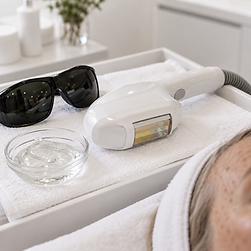
The skin is thoroughly cleansed and appropriate protective eyewear is used.
Recent tanning, sun exposure, skincare, medications and relevant medical history are taken into account before treatment.
3. I Select the Appropriate DPL Filter and Settings
The wavelength band and treatment parameters are selected according to the pigmentation, skin and treatment area rather than simply using one setting for everybody.
4. Controlled Pulses of Light Are Delivered
The DPL handpiece is placed over the treatment area and controlled pulses of filtered light are delivered into the skin.
Most people describe the sensation as a brief warm flick or elastic-band snap.
5. The Pigment May Darken
This is often exactly what I want to see.
Suitable pigmented areas can become temporarily darker after treatment before gradually fading or clearing.
6. Your Skin Is Allowed to Settle
You will be given appropriate aftercare.
Sun protection is particularly important after pigmentation treatment.
Focused Pigmentation Treatment | £75
For a smaller number of suitable sun spots, age spots, freckles or localised areas of pigmentation.
Ideal if you have several obvious brown marks rather than widespread facial pigmentation.
Approximate treatment time: 20 minutes
Full Face Pigmentation & Sun Damage | £135
For more widespread freckles, mottled sun damage or pigmentation affecting several areas of the face.
Approximate treatment time: 30 to 45 minutes
Back of Hands | £90
For suitable sun spots and age-related pigmentation across the backs of the hands.
Approximate treatment time: 20 to 30 minutes
Face + Neck OR Décolletage | £165
For suitable pigmentation extending beyond the face onto either the neck or upper chest.
Approximate treatment time: 45 to 60 minutes
Pay As You Go;
Your 6th Treatment Is Free
Most clinics offer their best price only when you pay for a full treatment course upfront.
I appreciate that paying for several sessions in one lump sum is a big outlay, so I do things differently.
Book and pay for your treatments individually as you go. Once you have completed five paid sessions of the same treatment area, your 6th session is free.
The saving of getting your 6th session free works out the same as clinics offering a discount over booking all 6 sessions, but the difference here is that you will not have to pay the course upfront - you pay as you go per session but still get the same saving in the form of the 6th session free.
So no large upfront payment. No commitment before you know how your skin responds. Just the same saving spread across your treatment journey.
Applies to the same treatment area and remains subject to continued treatment suitability.
DPL Pigment FAQs
What is pigmentation?
Pigmentation refers to areas where the skin contains more melanin than the surrounding skin, making them appear darker.
The important part is that pigmentation has many different causes, including sun exposure, genetics, inflammation and hormonal influences, so the correct treatment depends on what type of pigmentation it actually is.
Are sun spots, age spots and liver spots the same thing?
These terms are often used interchangeably.
Most flat brown “age spots” or “liver spots” on sun-exposed skin are actually solar lentigines, caused predominantly by cumulative UV exposure rather than anything to do with the liver.
Suitable solar lentigines can respond very well to light-based pigmentation treatment.
Can DPL remove freckles?
Suitable freckles can be significantly lightened with DPL because the treatment targets melanin within the pigmented areas.
However, treatment does not remove your genetic tendency to produce freckles.
UV exposure can make existing freckles darken again and encourage new pigmentation to develop, so ongoing sun protection matters.
Can DPL remove sun damage?
It can improve the pigmented component of sun damage, such as sun spots, freckles and mottled brown pigmentation.
Sun damage can also include redness, rough texture, fine lines and loss of elasticity, which are different targets.
If your main concern is overall skin quality rather than brown pigmentation specifically, a skin rejuvenation treatment may be more appropriate.
Can you treat melasma with IPL or DPL?
I do not treat melasma as though it is ordinary sun pigmentation.
Melasma is a more complex and reactive pigmentation disorder and can sometimes be aggravated by heat, inflammation or inappropriate light treatment.
If I think your pigmentation may be melasma, I will discuss that with you rather than simply treating it with the same settings I would use for a sun spot.
Can DPL treat brown marks left after acne?
Possibly, depending on what the mark actually is.
Brown marks after acne are usually post-inflammatory hyperpigmentation, while pink or red marks are generally vascular post-inflammatory erythema.
They need different treatment approaches.
Because pigment-prone skin can sometimes make more pigmentation following irritation, PIH is assessed individually rather than automatically treated.
Why do my brown spots look darker after treatment?
This is a normal and often desirable response with suitable superficial pigmentation.
The treated melanin absorbs the light energy and the pigmented area can temporarily become darker before gradually clearing.
It may develop a dry or slightly speckled appearance before naturally flaking or fading.
Do not pick or exfoliate it away.
How many treatments will I need?
There is no single number that applies to everybody.
A few superficial sun spots may respond very differently from widespread mottled pigmentation.
I prefer to treat, allow the skin to settle and assess the response rather than selling everybody an arbitrary course upfront.
Some clients may only need a small number of treatments, while others may choose additional sessions for more extensive pigmentation.
Does pigmentation treatment hurt?
Most people describe DPL pigmentation treatment as a very brief warm flick or snapping sensation.
The treatment is quick and individual pulses only last a fraction of a second.
Can pigmentation come back after treatment?
Yes.
Treatment can clear or reduce the pigmentation that is present, but it cannot stop your skin producing melanin in the future.
Sun exposure, hormones, inflammation and your natural skin behaviour can all contribute to new pigmentation.
Consistent SPF is therefore an important part of maintaining the result.
Can I have DPL pigmentation treatment if I am tanned?
No active tan should be treated.
Melanin within a tan also absorbs light, which means there is less distinction between the pigmentation being targeted and the surrounding skin.
Recent sun exposure, tanning and fake tan therefore need to be discussed before treatment.
Can you treat a mole or a raised brown mark?
No.
I do not use DPL cosmetically to remove moles or any pigmented lesion where the diagnosis is uncertain.
If a mark is new, changing, irregular, raised, bleeding, repeatedly crusting, noticeably different from your other lesions or simply does not look appropriate for cosmetic treatment, I will advise medical assessment instead.
IPL / DPL Pigment Treatment Near Norwich
Alison Mary Aesthetics is a private clinic in Taverham, Norwich, offering DPL pigmentation treatment for suitable freckles, sun spots, age spots and areas of uneven pigmentation.
The clinic has free private on-site parking and offers a quiet, discreet treatment setting.
Clients visit from Norwich, Taverham, Drayton, Costessey, Hellesdon, Horsford and across Norfolk for aesthetic, laser and advanced skin treatments.
Free private driveway parking is available.
Alison Mary Aesthetics Clinic
35 Broadgate
Taverham
Norwich
Norfolk
NR8 6GH
Page reviewed by Alison Mary
Aesthetic Practitioner and founder of Alison Mary Aesthetics Clinic, Norwich
Last reviewed: September 2026